The general’s salute hit me like shrapnel I’d thought I’d outrun, tearing thirty quiet years wide open in a single, public breath. I’d come as a father in a cheap flannel, content to clap and fade into the stands while my daughter became an officer without inheriting my ghosts. But when three stars stopped in front of me, eyes fixed on the scarred leather around my wrist, and called me “sir” over the stadium speakers, my past stopped pretending to be dead. It stood up, dusted off the sand, and walked straight toward my da… Continues…
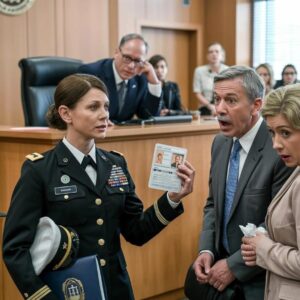
When Lieutenant General Mercer asked, “Where did you get Sergeant Holloway’s rescue band?” the air thinned, and the stadium’s roar flattened into a hum I could barely hear over my own pulse. Holloway’s name was a breach charge, blowing straight through thirty years of silence: the burning convoy, the smoke-thick radio, his bloody grin as he shoved the band into my hand and ordered me to live long enough to tell the story he wouldn’t. I’d failed that order—never told a soul, not even Emma, who’d grown up thinking her dad had only ever fought traffic and deadlines. Yet there was Mercer, hands shaking as he unfolded a sun-faded photograph of our squad, then a citation stamped MISSING beside my name. Emma’s fingers dug crescents into my sleeve as Mercer’s voice cracked over the PA, correcting the record in front of God, cadets, and every parent who’d just realized the stranger beside them might be carrying a war they’d nev… Continues…
The applause crashed over me, late and too loud, like a funeral that had shown up thirty years behind schedule but still insisted on doing every rite. Mercer’s voice softened as he finished the account of the ambush—of a stubborn driver’s son from Kentucky who blocked a burning road with his own vehicle, dragged bleeding men into a ditch, and refused to leave the dead behind. Then he said my old name—Staff Sergeant Michael Carter—and it didn’t vanish into the sky; it fell with a dull, undeniable weight at my daughter’s polished boots. Emma’s salute, meant for the flag, trembled and landed on me instead, her eyes asking questions her mouth hadn’t yet dared to form. The band on my wrist burned like it had just been buckled there in blood and smoke, every unspoken year tightening around my skin as the cadets chanted a motto I’d once believed I’d died reciting, and my carefully constructed civilian life started to fra… Continues…
Emma didn’t retreat from it. She stepped into it. After the ceremony, under a sky too blue for the ghosts it held, she stood between Mercer and me like a bridge we’d both been too afraid to build. “I grew up thinking you were just tired,” she said, voice unsteady, “not that you were missing in action with your own life.” The accusation hurt because it was true. I told her I’d wanted her to build her own service, unshadowed by mine, and that my silence had become its own kind of scar. She listened, jaw tight, then slipped her hand into mine like she was accepting a mission instead of an apology. When she took her oath, chin high and eyes red, every word stitched itself to a history she chose instead of inherited. At the truck, she laid her hand on the cab she’d once cursed for every missed recital and whispered, “I think this brought you home, not away.” The band on my wrist no longer felt like a sentence; it was a bridge. When she asked where we start, I said, “With Holloway.” With the men we buried and the ones who limped home. With every piece I’d finally speak aloud, riding beside my daughter in uniform, the truth no longer a weight I dragged alone but a story we carried forward, together.